
The government is more concerned with keeping itself in power than it is with furthering the process of democratization.
By TZ Business News Staff.
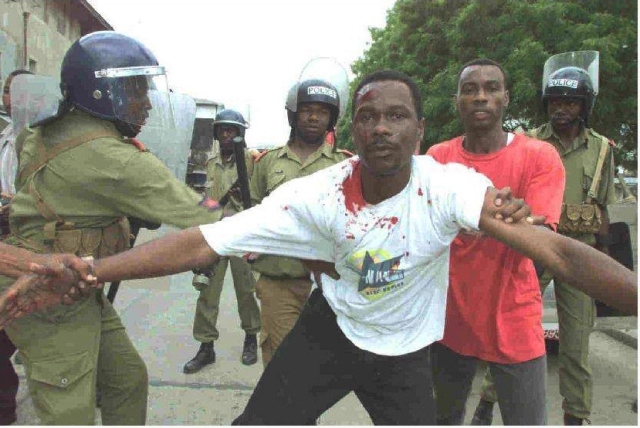
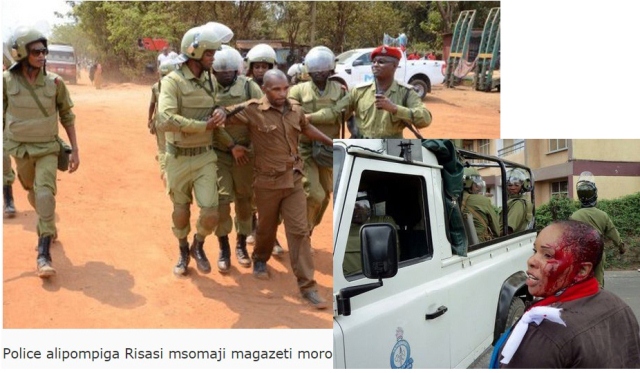
The international community is apparently concerned democracy is not making headway in Tanzania as citizens continue to live the horrors of a cruel police State which talks democracy but maims and kills people..
No major progress has been made toward democracy in Tanzania during the past three years, the German Bertelsmann Stiftung’s Transformation Index (BTI) 2014 has said. The review period starts on 31 January 2011 to 31 January 2013.
However, the report says, the activities of civil society groups, together with members of some of the opposition parties tacitly supported by factions within the ruling party, have enhanced the framework for free opinion and demand for accountability.
The BTI assesses the transformation toward democracy and a market economy as well as the quality of political management in 129 countries. Progress in democratization in Tanzania is dependent on external pressure that can only come from the international community, the report observes.
The country’s overall socio-economic development has continued to improve slightly. The elimination of corruption and bureaucratic barriers are crucial to maintaining growth and combating poverty effectively. The election results of 2010 underlined the continued stability of the mainland, although the opposition parties gained a substantial amount of votes vis-à-vis the ruling Revolutionary Party (Chama cha Mapinduzi, CCM), the party which has ruled the country now for [50] years.
The Party of Democracy and Development (Chama cha Demokrasia na Maendeleo, CHADEMA) became the strongest challenger to the ruling party and seems to have garnered strength since the last elections, the BTI report says.
There are still differences with respect to democratic politics between the mainland and Zanzibar. On the mainland (Tanganyika), government leaders are chosen in generally free, but not entirely fair, elections. There are, however, various factors limiting political participation to some degree.
In contrast to the mainland, general elections in Zanzibar, in which President Amani Abeid Karume won against Seif Sharrif Hamad, have been neither free nor fair. The separation of powers is assured, but the executive dominates. The judiciary functions relatively independently; it is regarded as inefficient and corrupt.
International donors as well as local reform activists continue to criticize the government for its reluctance in taking the necessary steps to effectively fight corruption. Tanzania has an essentially stable party system that is dominated by the former state party.
While the governing party is broadly anchored in society, opposition parties have yet to take sufficient hold in spite of some of their popular issues, such as corruption. Overall, the dominant position of CCM is in decline, but it nonetheless might be strong enough to secure an election victory in 2015. The landscape of interest groups is sparse, the report says. The majority of citizens support democracy.
Tanzania is one of the world’s least developed countries. It is heavily dependent on foreign aid and market competition is limited. The strength of the national economy fluctuates widely; there were some signs of improvement in recent years. Policies regulating price stability had shown positive results until the outbreak of the international financial crisis; Tanzania formerly had one of the lowest inflation rates in Africa. Currency policy has been less successful.
Property rights are legally guaranteed in principle, but corruption and inefficiency limit its effective enforceability. A comprehensive program for privatizing state enterprises is underway. Tanzania lacks an efficient state network to combat poverty. Only the latest reform policy focusing on education and health appears to have reversed the decline of health and education indicators.
For more than a decade, the country’s GDP showed a remarkable growth rate of 5% or more, often exceeding 6%, even during the recent global economic crisis. The IMF regards Tanzania’s macroeconomic conditions for further structural reforms as stable and favorable. Despite fundamental difficulties, the government is continuing to pursue strategic reform goals, particularly in the economic arena but less clearly in democratization.
No major policy changes have taken place since the elections in 2010. The process of reconciliation in Zanzibar showed progress when the CCM and the Civic United Front (CUF) formed a Government of National Unity after the 2010 elections. Oil and gas production may promise new avenues for growth, but might also ignite new debates over the union of mainland Tanzania and Zanzibar.
Concerned with losing political power, the CCM has not wholeheartedly embraced political transformation. Issues such as political repression, police brutality, and excessive police force have become common social concerns. Some politicians are fueling religious unrest for political gain, with the potential for long-term negative consequences.
Resource Efficiency
The government does not make efficient use of available human and organizational resources for its transformation policies. It still allows the considerable waste of limited public goods, and often lacks sufficiently qualified personnel to effectively utilize economic and political assets. Combating corruption has lost momentum, although the government started to intensify its anti-corruption policy by focusing on petty corruption at the middle and lower levels, but failed at the top level.
With the help of a cash budgeting system, the government can exercise relatively effective control over the use of appropriated funds according to budget plans, even though all quantitative goals have not been met; however, control is inadequate at almost all administrative levels. It is estimated that 20% of the ministries’ budget are lost to mismanagement and corruption.
Undemocratic Thinking
Aside from some members of the government in Zanzibar, no important political actors openly oppose the goal of establishing a market-based democracy. Only a small, non-influential group within the ruling party holds views more in tune with a socialist-based democracy. However, the commitment to such goals appears shallow among parts of the political and economic elite.
Some politicians in the ruling party – a “conservative” faction partly comprised of Ujamaa ideologues, more in tune with socialist doctrines – are skeptical of market economic goals, and there are different interpretations of what a Tanzanian democracy should look like.
Some politicians still place greater faith in a socialist rather than a liberal democracy. The majority of the political elite have accepted the principles of liberal democracy, but the democratic convictions of many seem to be shallow. Lip service is often paid to democratic principles, but actual understanding of politics reveals undemocratic thinking.
Management Performance
The government is pursuing strategic reform goals, particularly in the economic arena but less clearly in democratization. In the context of elections for parliament and the executive, the government is more concerned with keeping itself in power than with furthering the process of democratization.
There are still a number of regulations in place that allow the administration in a more or less subtle way to prevent the opposition from competing on equal footing – and the political leadership of the ruling party is in no way eager to change this “flexible” framework, which is suitable for repressive politics if necessary.
There are many politicians of the ruling party, as well as administrators down to the local level, who use these regulations for their own interests to maintain their privileged position. For example, this is indicated by the recent excessive use of police force, including the death of protesters, against small groups of demonstrators who did not receive a permit for their demonstration.
As regards good governance, much improvement is necessary. There is no progress in democratization. The fight against corruption is poorly implemented, despite many Implementation years of public declarations and new institutional arrangements. That the president asked six members of his government to resign in May 2012, after the Office of the Controller and Auditor General revealed corruption and mismanagement in several ministries, was only due to public pressure and in an attempt to “save face.”
Many other investigations in major corruption cases dragged on for many years, without results; such cases represented however just the beginnings of the fight instead of a serious attempt in combating deeply ingrained corruption among the political elite.
History and Characteristics of Transformation
An evaluation of transformation in Tanzania is complicated by the political partitioning of the United Republic of Tanzania (the union) into the Tanzanian mainland (formerly Tanganyika) and the two semiautonomous islands of Zanzibar (Pemba and Unguja), which have their own constitution, parliament, government and budget.
Developments have unfolded quite differently in these two parts of the country. On the mainland, the one-party system gave way quite peacefully to a multiparty system, while in Zanzibar transformation was marked by violent clashes and sustained repression of opposition parties, especially the Civic United Front (CUF). Zanzibar has remained an authoritarian regime within the Union.


